

Answer · Drawing requirements
What margins do patent drawings need?
Patent drawing sheets need margins of at least 2.5 cm at the top, 2.5 cm on the left, 1.5 cm on the right and 1.0 cm at the bottom. That leaves a drawing area of 17.0 x 26.2 cm on A4 and 17.6 x 24.4 cm on US Letter. The USPTO, EPO and PCT use the same four margins.
Draw this figure on a filing sheet
Upload a photo, sketch or CAD screenshot, or describe a method. You get black-and-white drawings with editable numerals on USPTO, EPO or PCT sheets. $19 for 40 drawings, one-time.
Open the drawing toolWhat the rule actually says
Each sheet must include a top margin of at least 2.5 cm. (1 inch), a left side margin of at least 2.5 cm. (1 inch), a right side margin of at least 1.5 cm. (5/8 inch), and a bottom margin of at least 1.0 cm. (3/8 inch) — 37 CFR 1.84(g)
These are minimums. You may leave more white space on any side, and you never get less. The same paragraph then caps the usable surface, which the rule calls the sight: no more than 17.0 x 26.2 cm on an A4 sheet and no more than 17.6 x 24.4 cm (6 15/16 x 9 5/8 inches) on a US Letter sheet. Pick the sheet size first, because the sight depends on it. The paper size page covers that choice.
The sheets must not contain frames around the sight (i.e., the usable surface), but should have scan target points (i.e., cross-hairs) printed on two catercorner margin corners. — 37 CFR 1.84(g)
Note the difference in wording. A frame is a "must not", while cross-hairs are a "should". Drawings exported from CAD often carry a title block and a border box from the drafting template. Remove both before filing, as explained in the CAD export guide. PCT Rule 11.6(c) sets the same four minimums for drawing sheets and also forbids frames around the usable surface.
The numbers in millimetres and inches
Top margin: 25 mm, or 1 inch. Left margin: 25 mm, or 1 inch. Right margin: 15 mm, or 5/8 inch (0.625 in). Bottom margin: 10 mm, or 3/8 inch (0.375 in).
The metric and inch figures in the rule are close, but they are not equal. One inch is 25.4 mm, so a 1 inch top or left margin is slightly more generous than 2.5 cm. Five eighths of an inch is 15.9 mm, again a little more than 1.5 cm. Three eighths of an inch is only 9.5 mm, which is half a millimetre short of 1.0 cm. If you set up the page in inches, round the bottom margin up to 0.4 inch (10.2 mm) so it clears both readings.
On A4 (210 x 297 mm, 8.27 x 11.69 in) the sight is 170 x 262 mm, about 6.69 x 10.31 inches. On US Letter (8.5 x 11 in, 215.9 x 279.4 mm) it is 176 x 244 mm, about 6.94 x 9.61 inches.
Worked example: an exploded chair on one Letter sheet
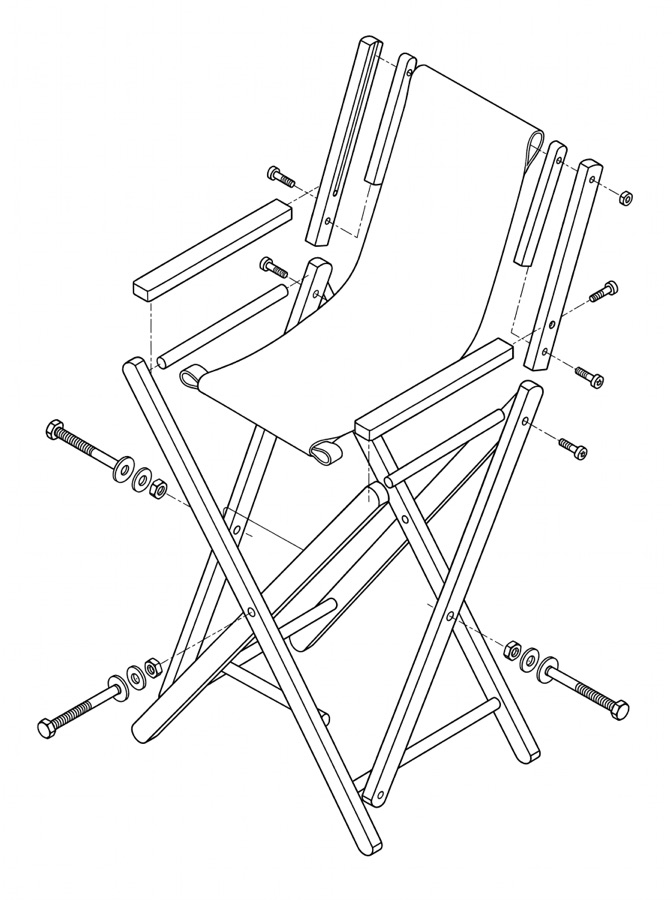
Our sample sheet (above) shows a folding camping chair pulled apart: two crossed leg frames, the seat sling, the backrest, the armrests, and the bolts, washers and nuts that hold them, each lined up with a dashed alignment line. Exploded views spread out by nature, so they are the figures most likely to touch the margins. The exploded view guide covers the drawing itself; here is the margin check, with example measurements.
Say the parts themselves fit in a box 150 mm wide and 220 mm tall. Now add the reference numerals. A numeral for the right-hand washer, placed 12 mm out on its lead line, pushes the right edge to about 168 mm. The FIG. 1 label below the chair adds roughly 12 mm of height, and the sheet number 1/3 sits at the top centre inside the sight. The total comes to about 168 x 240 mm, which fits the 176 x 244 mm Letter sight with 8 mm and 4 mm to spare.
If the same layout went onto A4, the width limit drops to 170 mm and the 168 mm figure would sit 2 mm from the edge. That still passes, but it leaves no room for a longer numeral like 112. When a numeral crosses the line, move the numeral and shorten its lead line, or tighten the explode distance along one dashed alignment line. Shrinking the whole figure also shrinks the text, and numerals must stay at least 3.2 mm tall, as covered in the text size guide.
In the sample project you can drag numerals toward the edge of a USPTO sheet and run the same format check your own project gets, without using credits.
Fitting a large figure without breaking the margins
If views wider than the width of the sheet are necessary for the clearest illustration of the invention, the sheet may be turned on its side so that the top of the sheet, with the appropriate top margin to be used as the heading space, is on the right-hand side. — 37 CFR 1.84(i)
On a turned sheet the 25 mm top margin moves to the right-hand edge of the upright page, and the sight becomes 262 x 170 mm on A4 or 244 x 176 mm on Letter. Words must still read left to right with the sheet turned. The sheet number follows the heading space, so place it as described in the sheet numbering guide.
If turning the sheet is not enough, split the figure into partial views such as FIG. 4A and FIG. 4B, or add a detail view of the crowded area at a larger scale. Both keep the numerals readable.
The details
Why the left and top are wider
The wider left margin leaves room for binding and the top margin leaves room for the office's own markings, such as the application number on replacement sheets.
Nothing in the margins
Figures, numerals, lead lines and FIG. labels must all stay inside the drawing area. Even one numeral that pokes into the margin is a common reason for an objection.
Sheet numbers
The sheet number (for example 1/4) goes in the middle of the top of the sheet but inside the drawing area, not up in the 2.5 cm margin.
Frame lines
Do not draw a border around the drawing area. The USPTO rules say the sheet must not contain frames around the sight, meaning the usable surface.
Common mistakes
- Leaving the CAD title block or border frame on the sheet
- Setting the bottom margin to exactly 3/8 inch, which is 9.5 mm and under the 1.0 cm figure
- Placing the sheet number up in the 2.5 cm top margin
- Letting a lead line or numeral run past the right edge of the sight on exploded views
Questions people also ask
Can I use US Letter at the EPO?
No. The EPO and PCT accept A4 only. The USPTO accepts A4 or US Letter, so A4 works everywhere if you plan to file abroad.
What if my figure does not fit?
Shrink it, split it into partial views labeled FIG. 3A and FIG. 3B, or turn the sheet sideways. Keep the numerals at least 0.32 cm tall after shrinking.
Does the tool check margins?
Yes. Each exported sheet is checked from its pixels for anything inside the margins and listed in the format report.
Official sources
Related questions
More in Drawing requirements
Draw this figure on a filing sheet
Upload a photo, sketch or CAD screenshot, or describe a method. You get black-and-white drawings with editable numerals on USPTO, EPO or PCT sheets. $19 for 40 drawings, one-time.
Open the drawing toolPatent drawing generatorThis page explains public rules and our tool. It is not legal advice; ask a registered patent attorney or agent about your application.