

Answer · Drawing requirements
What paper size do patent drawings use?
The USPTO accepts two sheet sizes: A4 (21.0 x 29.7 cm) and US Letter (21.6 x 27.9 cm, 8.5 x 11 inches). All drawing sheets in one application must be the same size. The EPO and PCT accept only A4, so if you may file abroad, drawing on A4 from the start saves reformatting.
Draw this figure on a filing sheet
Upload a photo, sketch or CAD screenshot, or describe a method. You get black-and-white drawings with editable numerals on USPTO, EPO or PCT sheets. $19 for 40 drawings, one-time.
Open the drawing toolThe rule text
All drawing sheets in an application must be the same size. One of the shorter sides of the sheet is regarded as its top. — 37 CFR 1.84(f)
The same paragraph lists the two allowed sizes: 21.0 x 29.7 cm (DIN A4) or 21.6 x 27.9 cm (8 1/2 x 11 inches, US Letter). Nothing else is accepted for drawing sheets at the USPTO, including Legal (8.5 x 14 in) and A3.
The size of the sheets shall be A4 (29.7 cm x 21 cm). — PCT Rule 11.5
PCT Rule 11.5 lets a receiving office accept other sizes, but the record copy sent to the International Bureau must be A4. In practice that means A4 for any international filing. The PCT drawing guide and the EPO drawing guide cover the other rules for those offices.
A4 and US Letter side by side
A4 is 210 x 297 mm, or 8.27 x 11.69 inches. US Letter is 215.9 x 279.4 mm, or 8.5 x 11 inches. Letter is 5.9 mm wider and 17.6 mm shorter.
After the margins of 25 mm top, 25 mm left, 15 mm right and 10 mm bottom, the usable area (the sight) is 170 x 262 mm (6.69 x 10.31 in) on A4 and 176 x 244 mm (6 15/16 x 9 5/8 in) on Letter. So A4 gives you a taller drawing area and Letter a slightly wider one. The margins guide explains each margin and the inch rounding issue on the bottom edge.
A sideways sheet swaps the numbers. With the sheet turned so its top is on the right, the sight becomes 262 x 170 mm on A4 or 244 x 176 mm on Letter. Use that for wide figures such as long tools, timing diagrams or a wide flowchart.
Paper itself has rules too, in case you ever file on paper: 37 CFR 1.84(e) asks for flexible, strong, white, smooth, non-shiny, durable sheets, used on one side only, and 1.84(x) asks you not to punch holes in them.
Worked example: moving the bottle section from Letter to A4
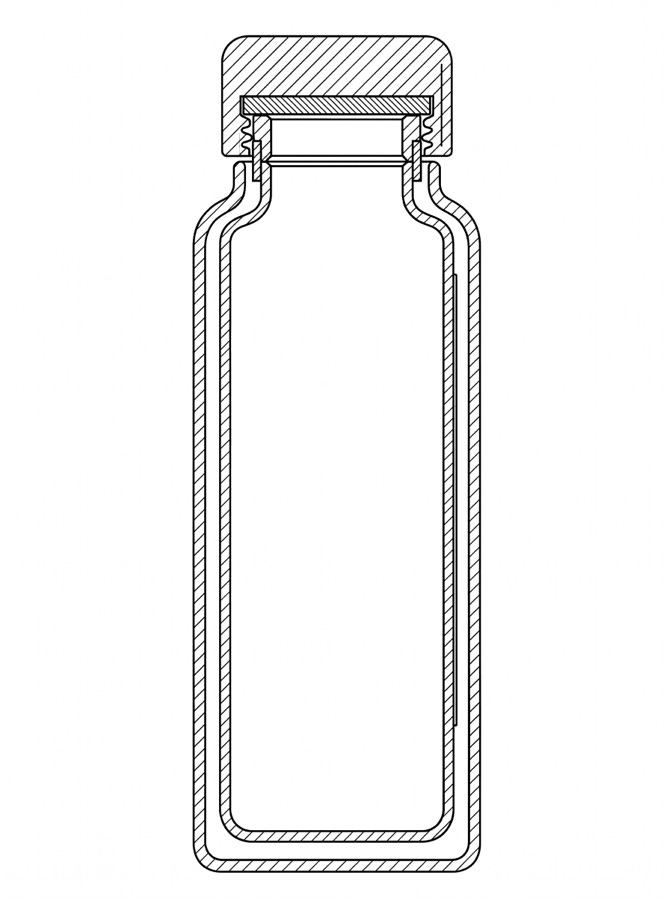
Our sample (above) is a tall, narrow cross-section of a double-wall insulated bottle: hatched cap, hatched inner and outer walls, and a white vacuum gap between them. The measurements below are an example layout. On a US Letter sheet, say the bottle is drawn 70 mm wide and 215 mm tall, with numerals 30 mm to its right at the end of their lead lines. With the FIG. 1 label below and the sheet number 1/2 at the top, the whole view needs about 100 x 240 mm, inside the 176 x 244 mm Letter sight.
Now you decide to file a PCT application and need A4. A tall figure like this gains room on A4, because the sight is 262 mm tall, so you can keep the same scale and leave 22 mm more white space. Nothing needs to shrink.
The opposite case is where sheets fail. Say another figure in the same set uses the full 176 mm Letter width, with numerals set at exactly 3.3 mm. Scaling it to the 170 mm A4 width is a 96.6 percent reduction, and the numerals drop to about 3.19 mm, just under the 3.2 mm minimum. Either set numerals at 3.5 mm from the start or move parts inward instead of scaling. The text size guide explains how to measure.
Whichever size you choose, every sheet in the application, including later replacement sheets, has to match it. The replacement sheet guide covers what changes on a corrected sheet.
How the tool handles sheet size
Each project lays out its sheets for one office. USPTO projects start on US Letter and can switch to A4. EPO and PCT projects use A4 only. After a switch, recheck each sheet: the format check on export reports any figure, numeral or label that now runs into a margin or falls under 3.2 mm. Plans are one-time: $19 for 40 drawings, $39 for 120 or $79 for 300, as listed on the pricing page.
The details
Portrait or landscape
Sheets are portrait. A figure too wide for the sheet may be drawn with the sheet turned on its side, so the top margin ends up on the right-hand side. Keep all such views facing the same way.
Usable area
After margins, A4 gives 17.0 x 26.2 cm for drawings and US Letter gives 17.6 x 24.4 cm.
File format
Electronic filings take PDF. The tool also exports TIFF for systems or offices that ask for it.
Choose before you draw
Pick the sheet size before laying out figures. Converting later is possible, but each figure has to be checked again for margins and text height.
Common mistakes
- Mixing A4 and Letter sheets in one set of drawings
- Scaling a full-width Letter figure to A4 without rechecking numeral height
- Using Legal, A3 or other sizes for a large figure
- Filing Letter sheets for a PCT application
Questions people also ask
Can I mix A4 and Letter?
No. Use one size for every drawing sheet in the application.
Does the size of the figure matter?
Make figures big enough that details stay clear at two thirds size. Small figures crowded on a sheet are a common objection.
Which size does the tool default to?
US Letter for USPTO projects and A4 for EPO and PCT. You can switch USPTO projects to A4.
Can I use Legal or A3 for a large figure?
No. Only A4 and US Letter are allowed for drawing sheets. Turn the sheet sideways or split the figure into partial views instead.
Official sources
Related questions
More in Drawing requirements
Draw this figure on a filing sheet
Upload a photo, sketch or CAD screenshot, or describe a method. You get black-and-white drawings with editable numerals on USPTO, EPO or PCT sheets. $19 for 40 drawings, one-time.
Open the drawing toolPatent drawing generatorThis page explains public rules and our tool. It is not legal advice; ask a registered patent attorney or agent about your application.